
Forty Generations of Family Ownership, Undone by One Decision
Every family that builds significant wealth eventually faces the same question: how do we honor what came before, and leave something durable for the generations that follow? Most families answer it with governance, meaning who leads, who decides, and how the family stays united. That answer is essential. As one of the longest-lived family enterprises in history shows, it is not enough on its own.
Kongō Gumi | 578–2006
Fourteen centuries to build. Two decades to undo.
578 C.E.
1980s–2006
578–1980s
Forty generations of family leadership, each leader chosen on merit rather than birth order.
1980s
Real estate bought near the peak of a bubble, in the same economy as the core business and financed with company debt.
2006
Weighed down by that debt, the company is sold, ending family ownership.
Kongō Gumi built Buddhist temples in Japan from 578 C.E. and was led by 40 generations of the same family. Its succession system was remarkable. Leadership did not pass automatically to the eldest son. It went to the family member of the right age best qualified to lead. Sons-in-law could be adopted into the family and become eligible, and several women led the company. For more than 1,400 years, the family’s governance did exactly what it was designed to do.
What it lacked was a financial structure to protect what that governance had built. In the 1980s, persuaded of the benefits of diversification, the family invested in Japanese real estate near the peak of a speculative bubble. The new holdings depended on the same economy as the temple business, and they were financed with debt carried by the operating company. When the bubble burst, both were impaired together, and a portfolio decision became a threat to the enterprise itself. By 2006 the company carried $343 million of debt against $68 million of revenue. It was sold, and 40 generations of family ownership came to an end.
Governance carried the Kongō family’s legacy for forty generations. Only structure could have protected it from a single decision.
The lesson for families today is that a lasting legacy needs both. Governance carries a family’s values and decisions forward. Financial structure protects them: wealth held separately from the risks of any one enterprise, diversification across exposures that are truly different, and written policies that size new commitments and settle who may authorize borrowing. With those in place, a single decision tests the family. Without them, it can end the legacy.
That kind of structure does not require a large family office. The Family Office Association’s guidance treats a dedicated single-family office as generally viable at roughly $100 million or more in investable assets. Below that level, a multi-family or virtual office is usually more practical, with services provided by outside advisors and coordinated by one of them. What matters is not the size of the staff, but whether the structure exists.
Many established offices still have gaps. In the UBS Global Family Office Report 2026, only 35% of responding offices had a succession plan for the family office itself, and just 27% had an organized process to prepare the next generation.
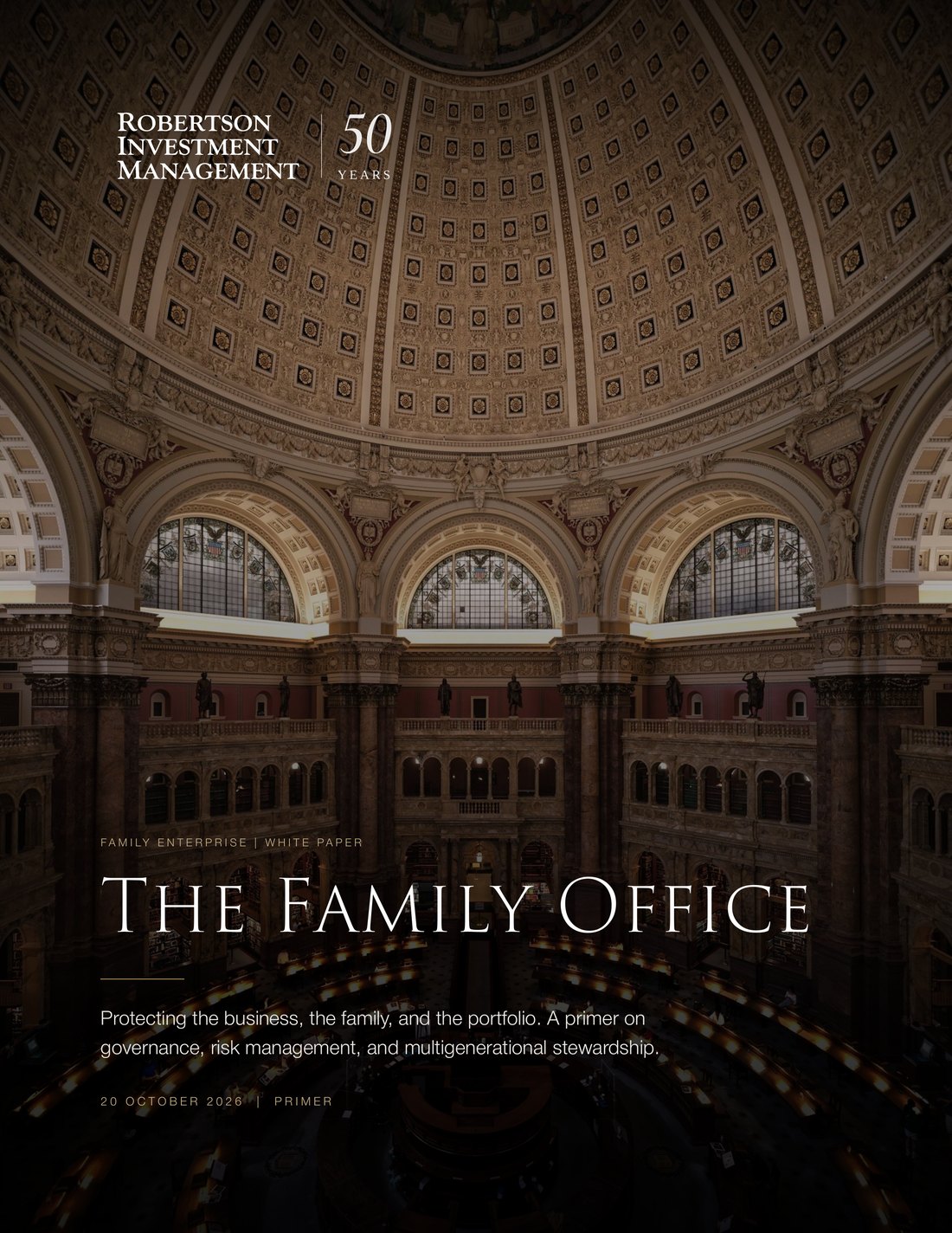
Our new primer, The Family Office, written by John H. Nghiem, Managing Director, explores how families can build both kinds of structure. It covers governance across family, ownership and management; risk across the family’s total balance sheet; seven family histories, including Kongō Gumi; and a practical framework for prevention. It also describes how Robertson can serve as the family’s quarterback, coordinating the attorneys, accountants and other advisors who support it.
White Paper | 45 Pages
The Family Office
Protecting the business, the family, and the portfolio. A primer on governance, risk management, and multigenerational stewardship.